Thursday, February 3, 2011

Fire the cannons!

This project has a lot to do with Boyles gas law.  Boyles gas law states that pressure and volume are indirectly proportional, meaning, when one goes up the other goes down.  The way my team and I related this to our project is that we made the barrel of the cannon small so when we put the nerf ball into the barrel more pressure would build up and shoot the nerf ball farther.

The way we will launch the cannons is by creating the chemical reaction between ethanol and oxygen in the bottom of the barrel.  This should throw the nerf ball.

Balanced Chemical Equation: 
C2H5OH+3O2  à 2CO2+3H2O   
Stay tuned in the spring for the launch of the cannons!!!

Procedure


1.   First our group thought of the angle of the barrel that would propel the nerf ball a descent distance.
2.   Then we sketched what the cannon would look like, keeping the angle of the barrel in mind.
3.   We then marked on the tennis ball tubes where we were going to cut.  On one of the tubes we marked a 45 degree angle on the side to refer to when cutting.
4.   Our team then taped the tubes together following the guidelines of our sketch and marks on the tubes.
5.   Finally we put our initials on our cannon and turned it into our teacher.


Wednesday, February 2, 2011

Math Component

A cannonball is shot upward from the upper deck of a fort with an initial velocity of 192 feet per second.  The deck is 32 feet above the ground. 

Quadratic Model: -16t2+192t+32
1.     How high does the cannonball go?  608 ft (Remember you are looking for a specific part of the vertex.)
2.     How long is the cannonball in the air? 12 seconds (Remember you can use the quadratic formula.)

Steps to Solve:

1.     Plug the numbers from the situation above into the quadratic model representing an object thrown into the air.
2.     Then plug the numbers into the function that finds the X of the vertex of the parabola (-b/2a).
3.     When the X of the vertex is obtained plug that number into the quadratic model and that will be how high the cannon goes.
4.     Plug the quadratic model into the calculator and go to the table.  The highest number under the X column (before the numbers start to turn negative) will be how long the cannonball stayed in the air.

English Component

Argument of the Ethics of Weapon Development:
There is a lot of argument on whether the development of weapons is right or wrong.  The good thing about developing weapons is that you can feel safer with something that can protect you in your home or in your nation.  The bad thing about developing weapons is it provokes violence between people and countries.  It also costs a lot of money to keep inventing new weapons for the military.

I personally do not feel it was right to give weapons to the boy soldiers in Sierra Leone.  It created more violence and chaos in an already corrupt country.  Judging by what happened to Ishmael Beah in his memior A Long Way Gone, weapons took away his childhood and made him into a moster who was plagued in the mind. 

Monday, January 31, 2011

History of Cannons

Pre-1800s Cannons
Hand Cannon
Manufacture:
- Unknown
- Earliest documented use was from Arabic manuscripts
Design:
- Simple Weapon
- Barrel with a handle (many different designs)
- Touch hole drilled throught the side wall of the gun
- Flash pan (had leather cover, kept powder dry to prevent premature firing)
Battles:
- Used in the battle of Ain Jalut in 1260 the invading Mongols by the Mamluks
Ammunition Types:
- Some fired pebbles found on the ground
- Shaped balles of stone
- Iron
- Arrows
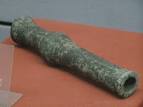


“Hand Cannon”.  Wikipedia.  12 Jan. 2011.  17 Jan. 2011.  1:20.  <http://en.wikipedia.org/wiki/hand_cannon>

Carronade
Manufacture:
- Developed for the Royal Navy by the Carronade Company (an ironworks in Falkirk, Scotland)
Design:
- Low muzzle velocity, short-range naval weapon
Battles:
- Fought on ships, known as the smasher because it would devastate the enemy vessel, caused massive splinters
- Became popular on British merchant ships during American Revolutionary War
Ammunition Types:
- Used grapeshot ammunition


“Carronade”.  Wikipedia.  18 Dec. 2010.  13 Jan. 2011.  2:10. <http://en.wikipedia.org/wiki/carronade#history> 
“Carronade”.  HMS Victory.  16 Jan. 2011.  6:06. 
  <http://www.hms-victory.com/index.php?option=com_content&task=view&id=61&Itemid=91>


1800-1900s Cannons
Howitzer
Manufacture:
- Invented by the Dutch in the 17th century
Design:
- Significantly heavier than earlier howitzer
- Became more "gun-like" in early 1900s (longer barrel, higher velocities, larger propelling charges, smaller shells, flatter trajectories)
Battles:
- Civil War
- Russo-Turkish War
- World War I
Ammuntion Types:
- Shells

modern howitzer

“Howitzer”.  Wikipedia.  10 Jan. 2011.  18 Jan. 2011.  10:39.  <http://en.wikipedia.org/wiki/howitzer>
“Cannon- Howitzers”.  The Pirate King.  18 Jan. 2011.  10:42.  <http://www.thepirateking.com/historical/cannon_howitzers.htm
“Modern Howitzer”.  Visual Dictionary Online.  18 Jan. 2011.  10:45.  http://visual.merriam-webster.com/society/weapons/modern-howitzer.php


Mortars
Manufacture:
- Sir Wilfred Stokes devised modern mortar transportable by one person in 1915
- The Germans also developed mortars during World War I
Design:
- Indirect fire weapon
- Fires shells at low velocity, short ranges and high-arching ballistic trajectories
- Barrel, base plate and bipod
Battles:
- Worls War I
- Russo-Japanese War
Ammunition Types:
- Shells/bombs
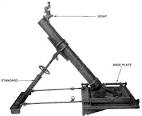


“Mortar Weapon”.  Wikipedia.  12 Jan. 2011.  18 Jan. 2011.  9:40.  <http://en.wikipedia.org/wiki/Mortar_(weapon)#History>  
24 July 2010.  18 Jan. 2011.  9:47.  <http://www.rt66.com/~korteng/SmallArms/4pt2M2.htm>


1900s Modern Cannons
Bradley Fighting Vehicle
Manufacture:
- BAE Systems Land and Armaments
- Used by United States and Saudi Arabia
Design:
- Holds three crew men (commander, gunner, driver) and six fully equipped soldiers
- As fast as the M1 Abrams
- Primary Armament is a 25 mm cannon, fires up to 200 rounds per minute and is accurate up to 2500 meters
Battles:
- The Iraq War
Ammuntion Types:
- Shells


“Bradley Fighting Vehicle”.  Wikipedia.  22 Jan. 2011.  22 Jan. 2011.  10:26.  http://en.wikipedia.org/wiki/Bradley_Fighting_Vehicle  


Ariete
Manufacture:
- Main battle tank of the Italian army
- Developed by a consortium formed by Iveco-Fiat and Ota Melara
Design:
- Carries the latest optical digital-imaging and fire control systems enabling it to fire day and night and fire while moving
- Mounted with 120 mm smoothbore cannon
Battles:
- Iraq War
Ammunition Types:
- APFSDS (armor-peircing fin-stabalised)
- HEAT (high explosive ant-tank)

Ariete tank.JPG


Ariete”.  Wikipedia.  24 Dec. 2010.  23 Jan. 2011.  5:48.  http://en.wikipedia.org/wiki/C1_Ariete
Ariete - Definition”.   WordiQ.  23 Jan. 2011.  5:51.  http://www.wordiq.com/definition/Ariete 


Economic Impact:
When the cannon was made the new weapon was a great acheivement.  The cannon created new bussinesses and jobs for people which helped money flow.  This weapon, when used in wars, could defeat the opposing party and help the other party take the enemies money and take over their nation.

Social Impact:
The cannon could construct or deconstruct relationships. It depends on the situation. In a war, if the cannon helps one nation win, that nation could take over their enemies land and force a relationship between the two countries or destroy the one they had had before.